 Image 1 of 1
Artist Rod Hughes
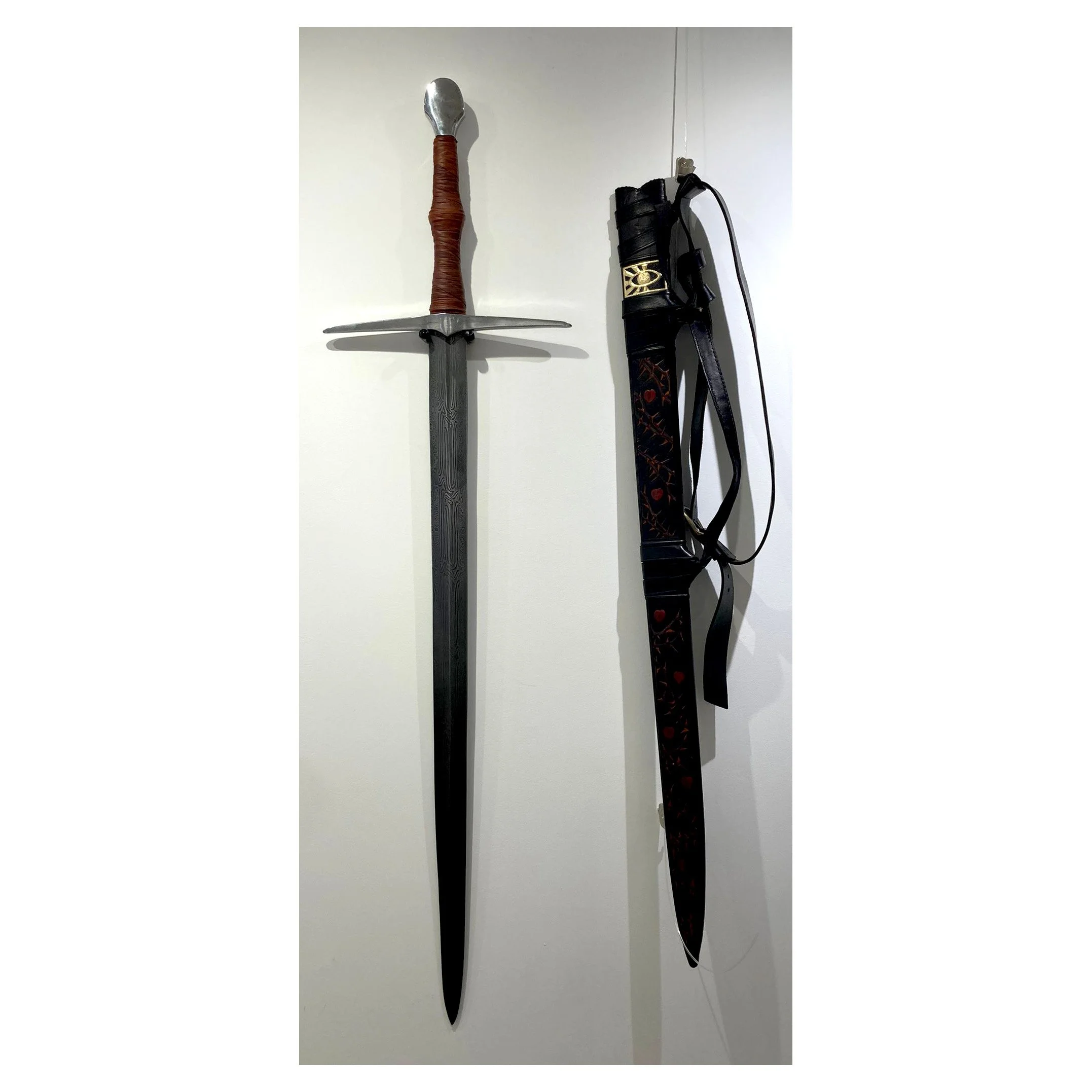
Sword - STEEL, WROUGHT IRON, ASH & LEATHER SCABBARD
117cm
This double-handed broadsword draws inspiration from earlier medieval and pre-medieval traditions, particularly through its pattern-welded blade. Pattern welding, a technique used from the early medieval period and before, involved twisting and forging together layers of iron and steel to create both strength and distinctive flowing patterns within the blade. Long before the development of high-quality steel, this method allowed smiths to produce weapons that were both functional and visually striking, often associated with status and craftsmanship.
By the later medieval period, large two-handed swords emerged as powerful battlefield weapons, capable of delivering heavy blows and controlling space in combat. Though simpler in construction than earlier pattern-welded blades, they continued the tradition of the sword as both a practical weapon and a symbol of authority and skill.
The thorn pattern featured on the scabbard echoes a long-standing symbolic language found in medieval art and legend. Thorns were often associated with protection, sacrifice, and endurance, most notably through the imagery of Christ’s crown of thorns. In a landscape such as Glastonbury, this symbolism also resonates with local tradition, recalling the Holy Thorn and the blending of Christian and mythic storytelling.
In combining ancient blade-making techniques with later medieval form and symbolic decoration, this piece reflects the layered nature of history itself, where craft, belief, and story are continually reworked and carried forward.
Artist Rod Hughes
Sword - STEEL, WROUGHT IRON, ASH & LEATHER SCABBARD
117cm
This double-handed broadsword draws inspiration from earlier medieval and pre-medieval traditions, particularly through its pattern-welded blade. Pattern welding, a technique used from the early medieval period and before, involved twisting and forging together layers of iron and steel to create both strength and distinctive flowing patterns within the blade. Long before the development of high-quality steel, this method allowed smiths to produce weapons that were both functional and visually striking, often associated with status and craftsmanship.
By the later medieval period, large two-handed swords emerged as powerful battlefield weapons, capable of delivering heavy blows and controlling space in combat. Though simpler in construction than earlier pattern-welded blades, they continued the tradition of the sword as both a practical weapon and a symbol of authority and skill.
The thorn pattern featured on the scabbard echoes a long-standing symbolic language found in medieval art and legend. Thorns were often associated with protection, sacrifice, and endurance, most notably through the imagery of Christ’s crown of thorns. In a landscape such as Glastonbury, this symbolism also resonates with local tradition, recalling the Holy Thorn and the blending of Christian and mythic storytelling.
In combining ancient blade-making techniques with later medieval form and symbolic decoration, this piece reflects the layered nature of history itself, where craft, belief, and story are continually reworked and carried forward.