 Image 1 of 1
Artist Rod Hughes
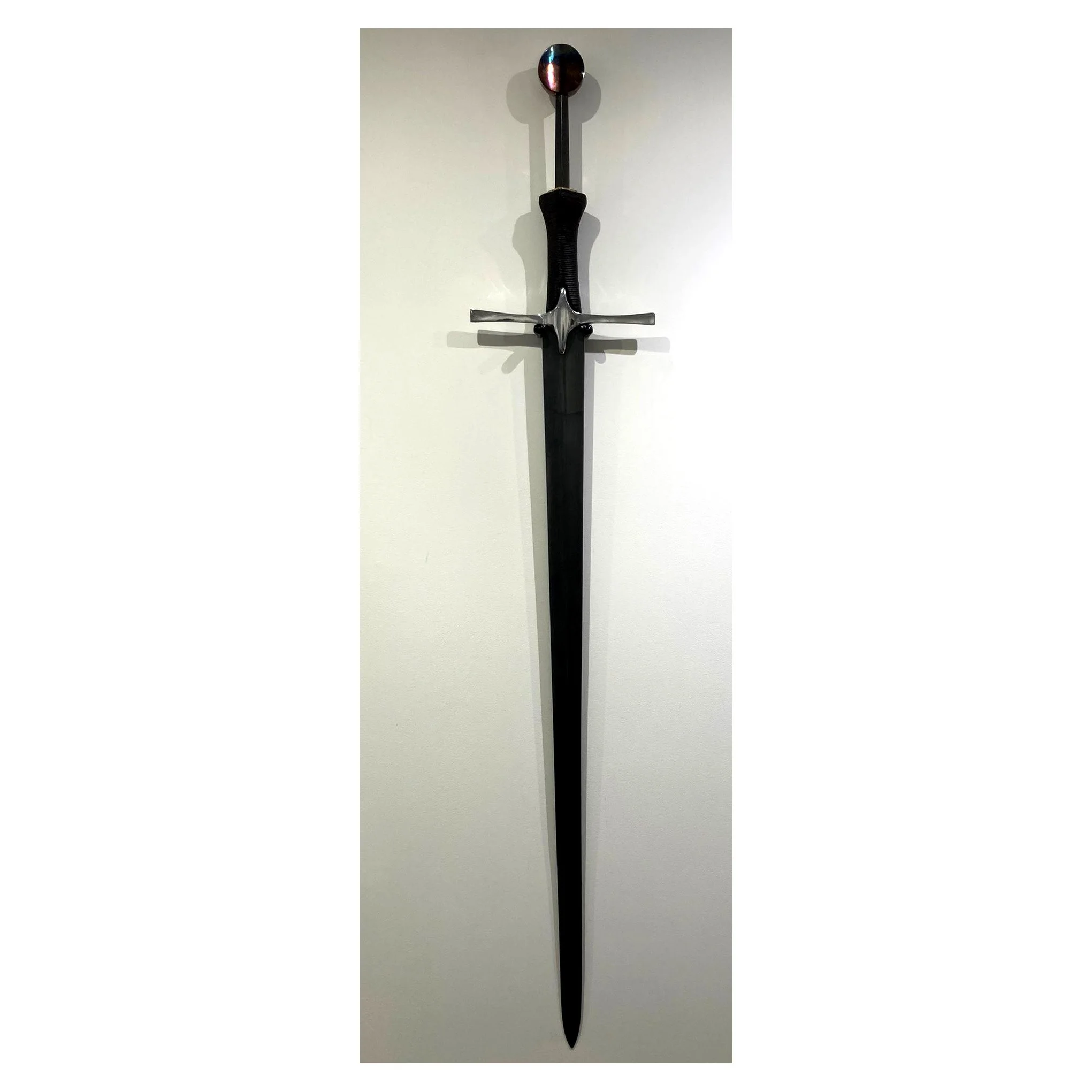
Sword - MONO STEEL, IRON & LEATHER
123cm
This sword is based on a 15th-century example held in the Metropolitan Museum of Art in New York, representing a type widely used across late medieval Europe. Often referred to as a “hand-and-a-half” sword, or more colloquially a “bastard sword,” it takes its name from its ability to be used in two ways, either single-handed or with both hands for greater control and power.
The term “bastard sword” reflects this in-between nature. It is neither a true one-handed arming sword nor a fully two-handed weapon, instead occupying a middle ground that offered versatility on the battlefield. This adaptability made it especially valuable during a period when combat was rapidly changing.
By the 15th century, full plate armour had become highly advanced, forcing weapons to evolve in response. Rather than relying on broad cutting blows, swords of this kind were designed with narrower, tapering blades suited to thrusting into the small gaps in armour, such as the joints, visor, or under the arm. Fighting techniques also adapted, with warriors gripping the blade itself to guide precise strikes in close combat.
Despite its size, the sword was not excessively heavy, typically weighing little more than 1.5 kilograms. Its balance and long grip allowed for speed, control, and fluid movement, whether used on foot or on horseback. It was as much a weapon of skill as of strength.
This type of sword represents a turning point in medieval warfare, where refinement, technique, and adaptability became as important as force. In its form, it reflects a world in transition, caught between older traditions of combat and the increasingly specialised nature of late medieval battle.
Artist Rod Hughes
Sword - MONO STEEL, IRON & LEATHER
123cm
This sword is based on a 15th-century example held in the Metropolitan Museum of Art in New York, representing a type widely used across late medieval Europe. Often referred to as a “hand-and-a-half” sword, or more colloquially a “bastard sword,” it takes its name from its ability to be used in two ways, either single-handed or with both hands for greater control and power.
The term “bastard sword” reflects this in-between nature. It is neither a true one-handed arming sword nor a fully two-handed weapon, instead occupying a middle ground that offered versatility on the battlefield. This adaptability made it especially valuable during a period when combat was rapidly changing.
By the 15th century, full plate armour had become highly advanced, forcing weapons to evolve in response. Rather than relying on broad cutting blows, swords of this kind were designed with narrower, tapering blades suited to thrusting into the small gaps in armour, such as the joints, visor, or under the arm. Fighting techniques also adapted, with warriors gripping the blade itself to guide precise strikes in close combat.
Despite its size, the sword was not excessively heavy, typically weighing little more than 1.5 kilograms. Its balance and long grip allowed for speed, control, and fluid movement, whether used on foot or on horseback. It was as much a weapon of skill as of strength.
This type of sword represents a turning point in medieval warfare, where refinement, technique, and adaptability became as important as force. In its form, it reflects a world in transition, caught between older traditions of combat and the increasingly specialised nature of late medieval battle.