
Rod Hughes
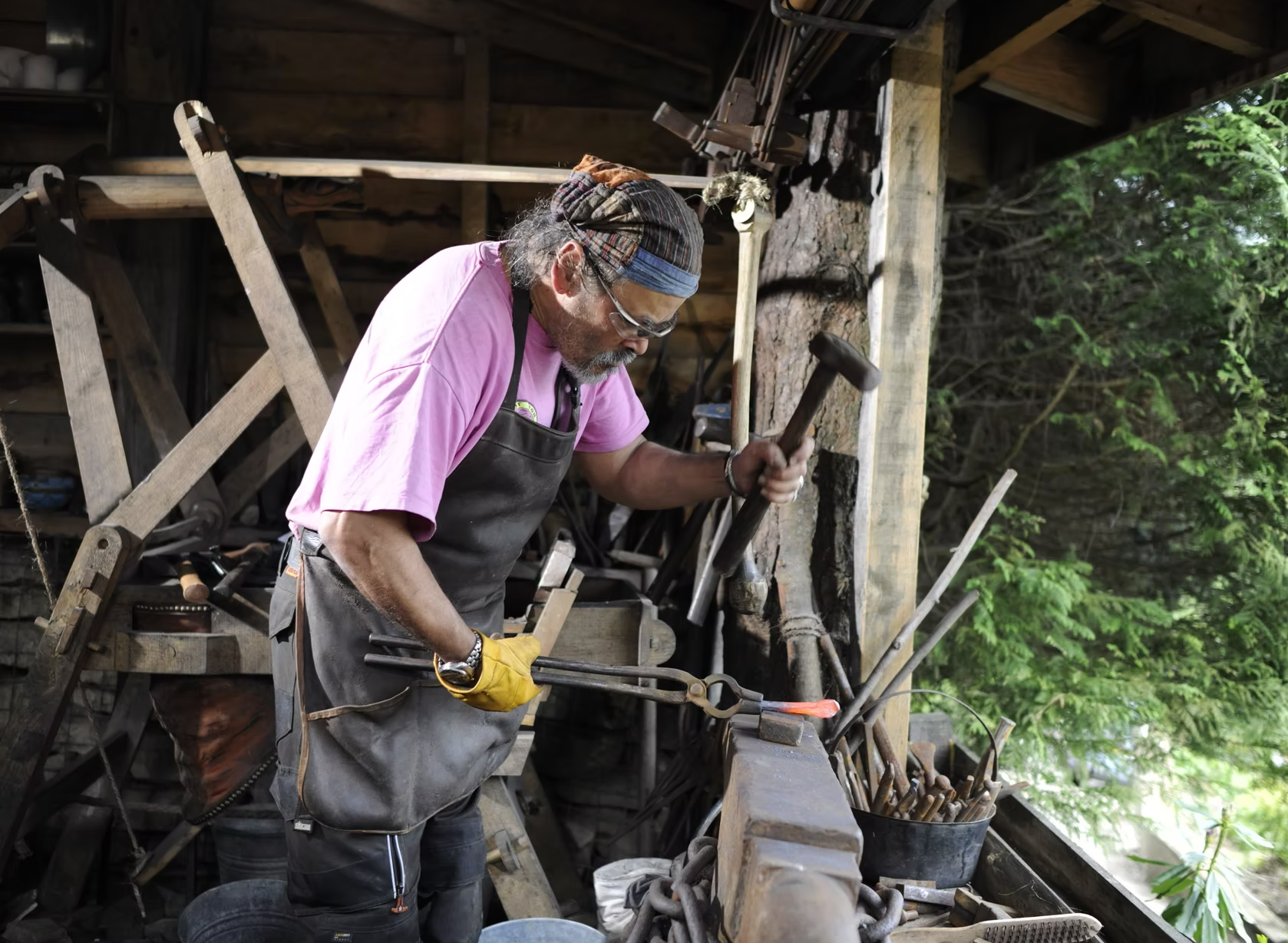
Rod is a bladesmith who specialises in making pieces of history and a film-maker based in Grayshott, Surrey. He makes swords as art and his work can be seen on TV and in museums.
Hughes works from his forge in Surrey, unusual in that it is a Viking forge which he constructed from local timber. Here Hughes uses charcoal and hand power to create his blades.
Rod has been a maker for over 50 years and works in iron, steel, copper, bronze, silver and gold, wood and bone.
Each piece is a hand-made reimagining of an ancient craft, the sorcery of fire and steel.
Despite coming to the profession late, Hughes has earned a reputation as a master craftsman of historical reproductions. His work, such as the Pirate Cutlass, is showcased in a selection of museums throughout the country and can now be seen at the Heart of The Tribe Gallery.
Artist Rod Hughes
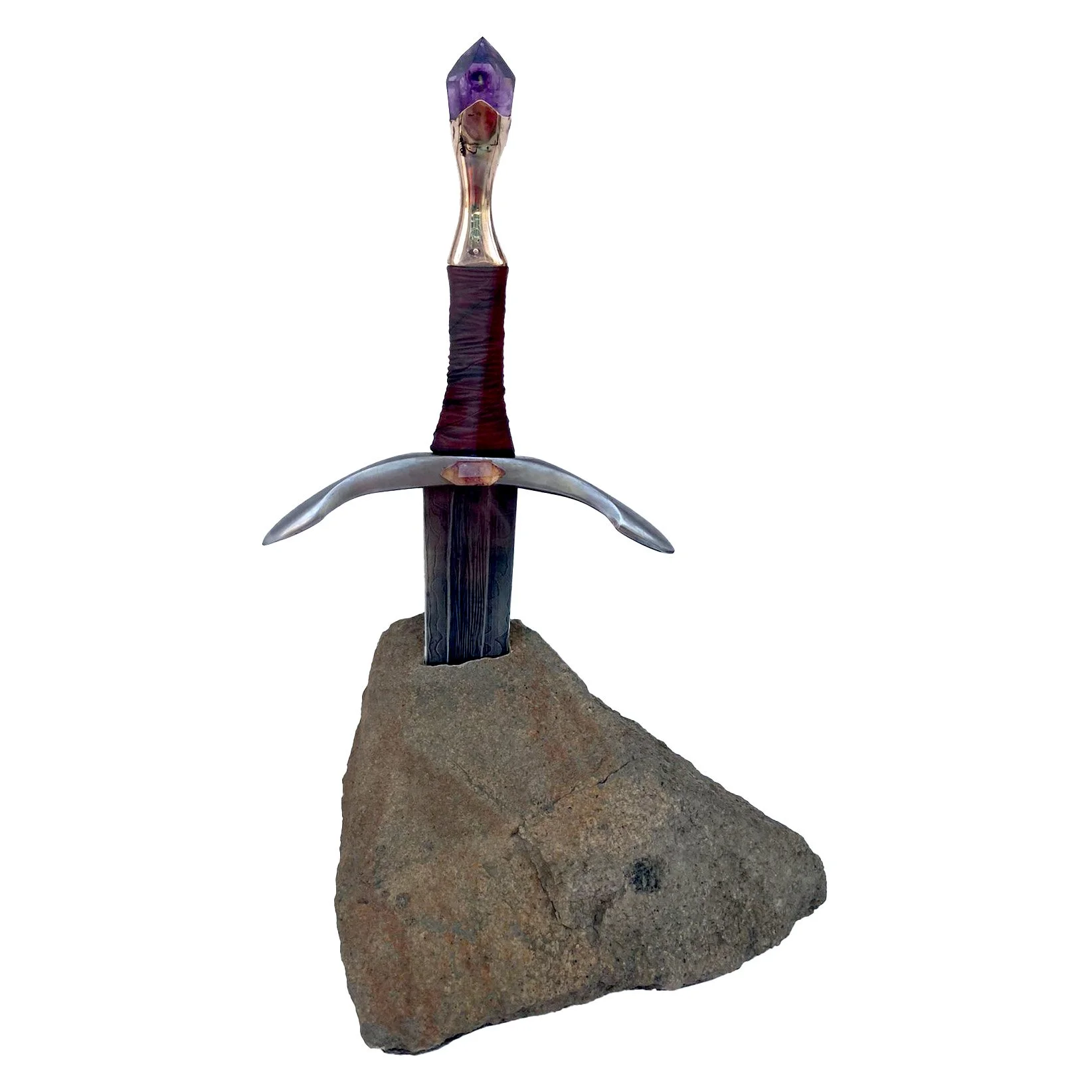
Sword in the Stone- GRANITE , STEEL, BRONZE, IRON, GRANITE , STEEL, BRONZE, IRON, AMETHYST & SILVER
The legend of King Arthur and Excalibur
Artist Rod Hughes
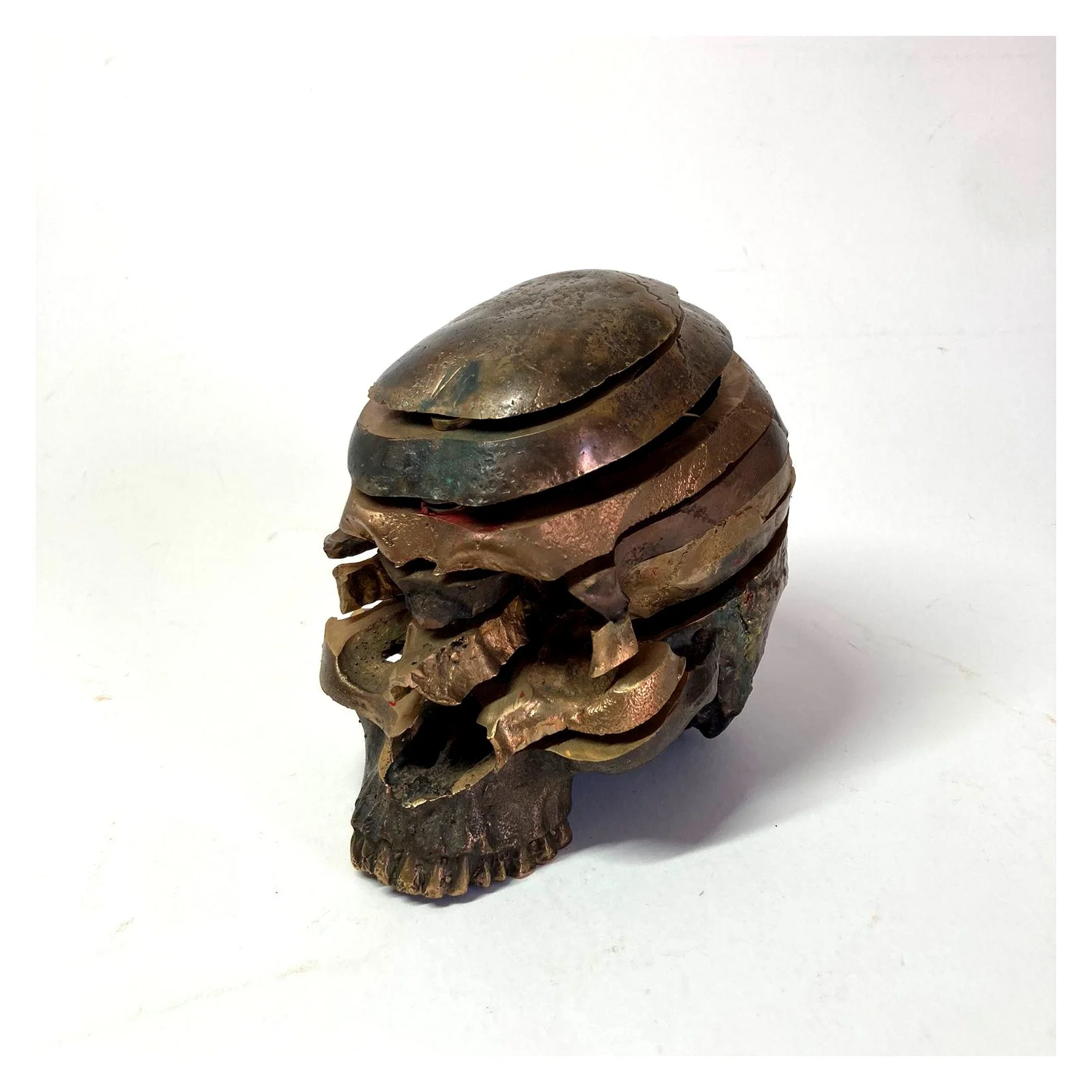
Bronze Skull: 14cm W x 15cm H x 18cm L
What connects this work to earlier traditions is not its form, but its craftsmanship and symbolism. The skull, formed in repoussé copper and bronze over a steel core, draws on a long visual language of mortality found throughout medieval and later European art. Such imagery served as a reminder of the fragility of life, an idea often captured in the concept of memento mori.
Artist Rod Hughes
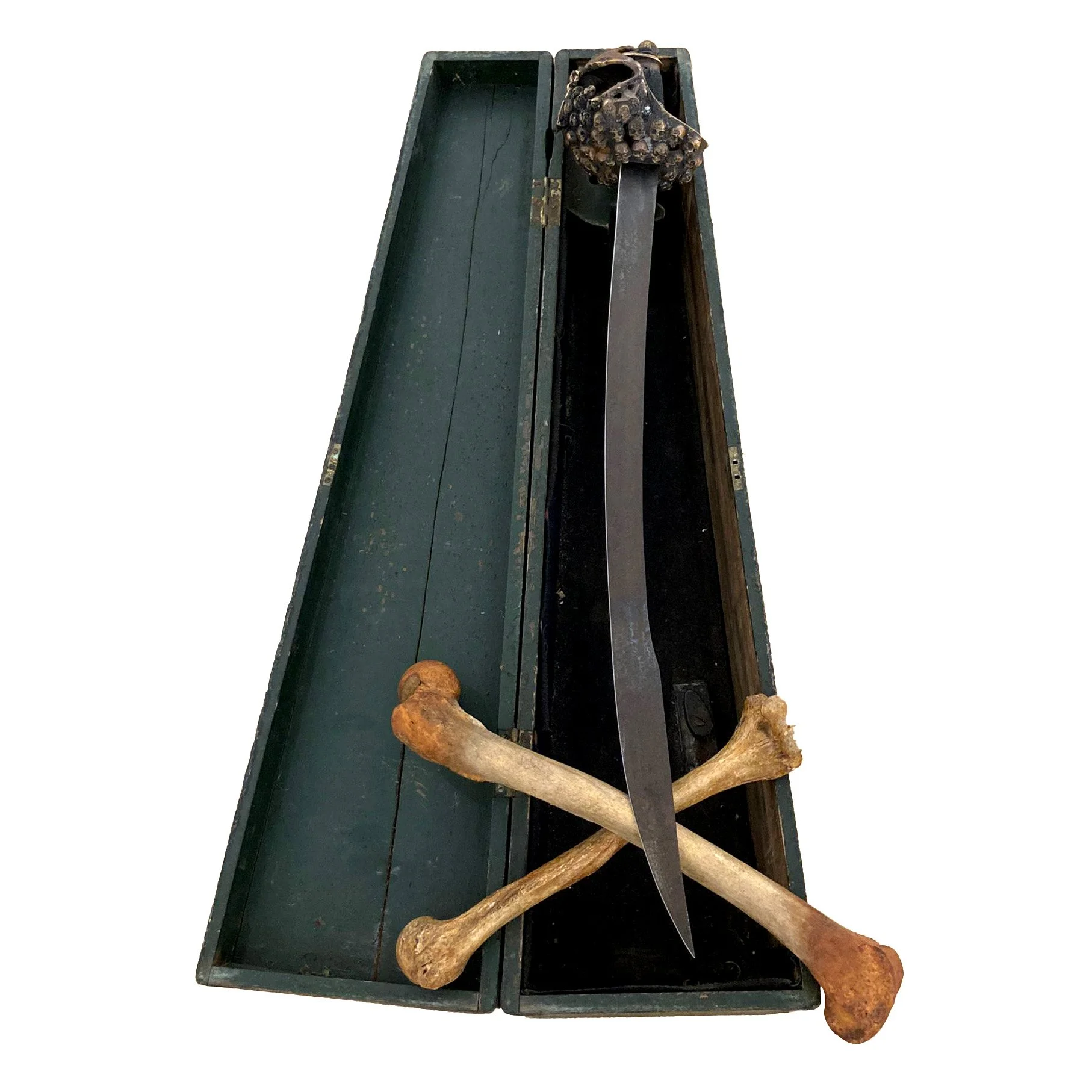
Sword - POLISHED STEEL, LEATHER & BRONZE WITH ANTIQUE BOX
Box: 46cm W x 17cm H x 88cm L
please note the bones are not included
Although not of the medieval period, this piece reflects the continuation of European blade-making traditions into later centuries. Cutlasses of this kind became associated with naval combat from the 17th century onwards, valued for their curved blades and effectiveness in close-quarters fighting.
What connects this work to earlier traditions is not its form, but its craftsmanship and symbolism.
The curved, heavily fullered blade and tactile sharkskin grip reflect a weapon designed for function as well as presence. Emerging from the skull itself, the blade creates a striking fusion of form and meaning, where weapon and symbol become one.
While later in origin, this piece sits naturally alongside medieval arms and armour, continuing the enduring relationship between craft, power, and the ever-present awareness of mortality.
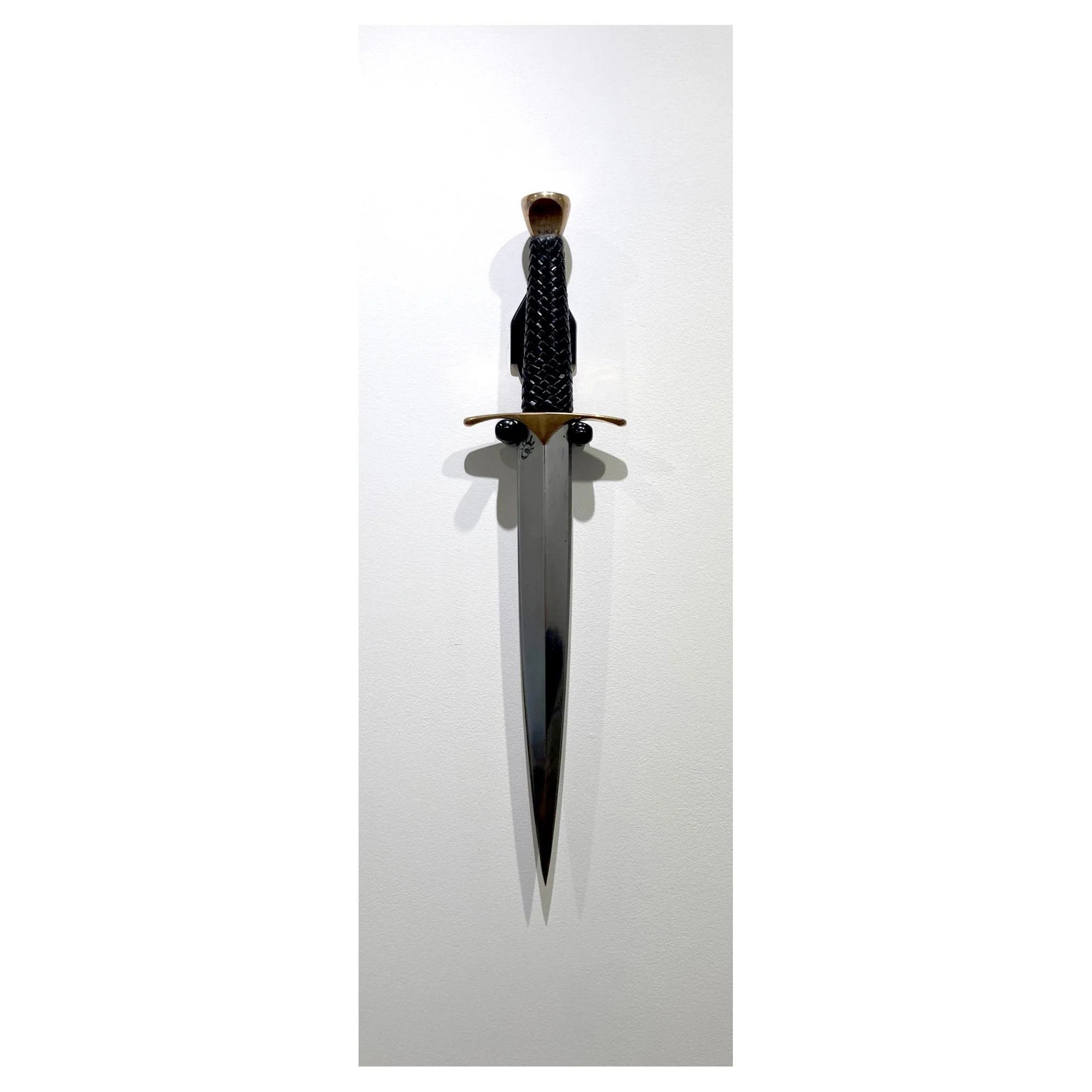
Artist Rod Hughes
Dagger - POLISHED STEEL, LEATHER & BRONZE
39cm
This dagger draws inspiration from the later medieval period, when such weapons were an essential part of both civilian life and warfare. Compact and easily carried, daggers were used as everyday tools as well as close-combat weapons, often worn at the belt and always within reach.
By the 14th and 15th centuries, daggers had become highly specialised. Designs grew more rigid and sharply pointed, intended not for cutting but for thrusting into the vulnerable gaps of armour, such as the joints, visor, or under the arm. In battle, they were often used at close quarters, where control and precision mattered more than strength.
Daggers also carried social meaning. They could signify status, craftsmanship, and personal identity, with details such as the grip, pommel, and decoration reflecting the owner or maker.
With its highly polished blade, tactile grip, and carefully finished fittings, “Goldeneye” reflects this dual nature, both practical and personal, a weapon designed for precision, yet shaped by the same tradition of craftsmanship and symbolism that runs through medieval arms and armour.
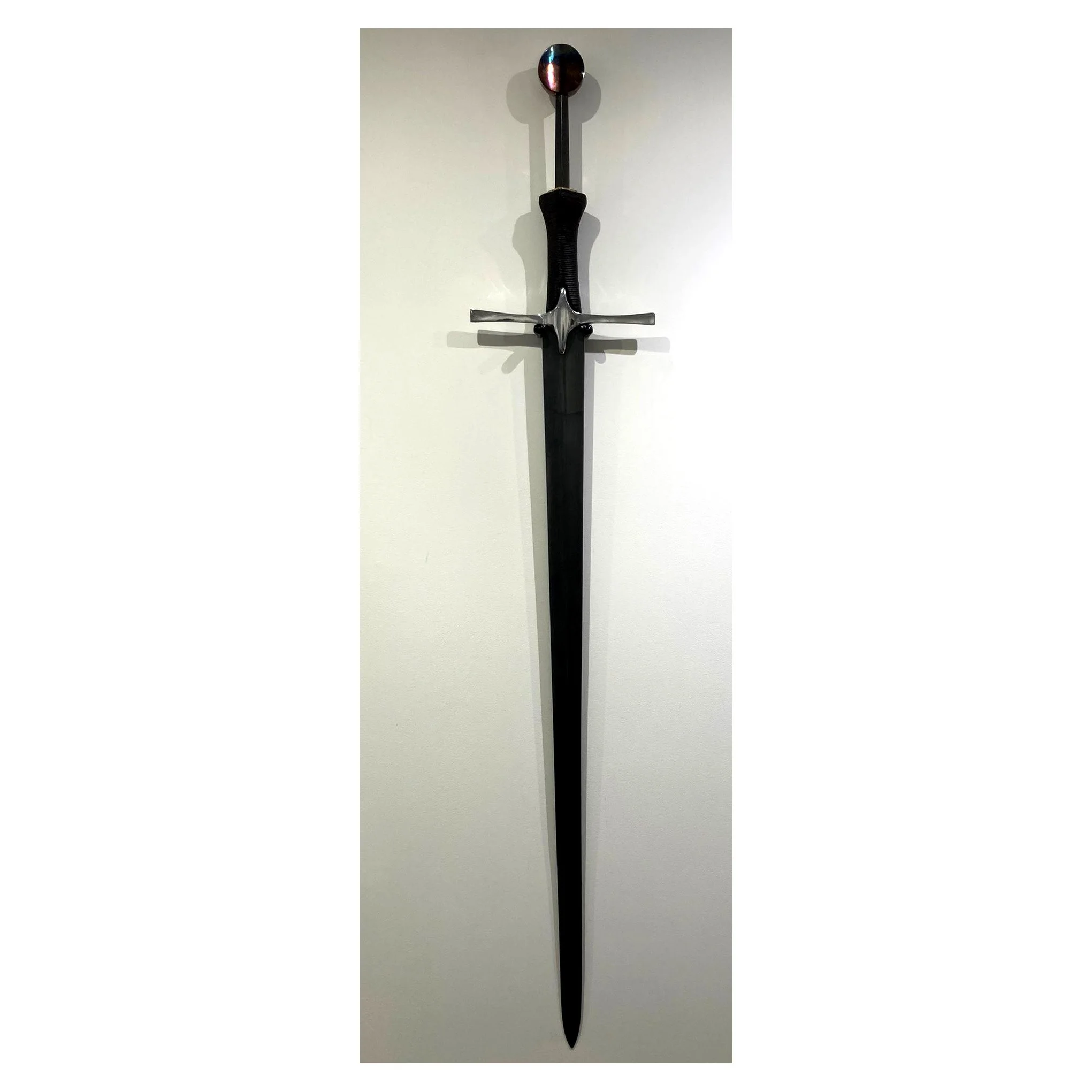
Artist Rod Hughes
Sword - MONO STEEL, IRON & LEATHER
123cm
This sword is based on a 15th-century example held in the Metropolitan Museum of Art in New York, representing a type widely used across late medieval Europe. Often referred to as a “hand-and-a-half” sword, or more colloquially a “bastard sword,” it takes its name from its ability to be used in two ways, either single-handed or with both hands for greater control and power.
The term “bastard sword” reflects this in-between nature. It is neither a true one-handed arming sword nor a fully two-handed weapon, instead occupying a middle ground that offered versatility on the battlefield. This adaptability made it especially valuable during a period when combat was rapidly changing.
By the 15th century, full plate armour had become highly advanced, forcing weapons to evolve in response. Rather than relying on broad cutting blows, swords of this kind were designed with narrower, tapering blades suited to thrusting into the small gaps in armour, such as the joints, visor, or under the arm. Fighting techniques also adapted, with warriors gripping the blade itself to guide precise strikes in close combat.
Despite its size, the sword was not excessively heavy, typically weighing little more than 1.5 kilograms. Its balance and long grip allowed for speed, control, and fluid movement, whether used on foot or on horseback. It was as much a weapon of skill as of strength.
This type of sword represents a turning point in medieval warfare, where refinement, technique, and adaptability became as important as force. In its form, it reflects a world in transition, caught between older traditions of combat and the increasingly specialised nature of late medieval battle.
Artist Rod Hughes
Sword - STEEL, WROUGHT IRON, ASH & LEATHER SCABBARD
117cm
This double-handed broadsword draws inspiration from earlier medieval and pre-medieval traditions, particularly through its pattern-welded blade. Pattern welding, a technique used from the early medieval period and before, involved twisting and forging together layers of iron and steel to create both strength and distinctive flowing patterns within the blade. Long before the development of high-quality steel, this method allowed smiths to produce weapons that were both functional and visually striking, often associated with status and craftsmanship.
By the later medieval period, large two-handed swords emerged as powerful battlefield weapons, capable of delivering heavy blows and controlling space in combat. Though simpler in construction than earlier pattern-welded blades, they continued the tradition of the sword as both a practical weapon and a symbol of authority and skill.
The thorn pattern featured on the scabbard echoes a long-standing symbolic language found in medieval art and legend. Thorns were often associated with protection, sacrifice, and endurance, most notably through the imagery of Christ’s crown of thorns. In a landscape such as Glastonbury, this symbolism also resonates with local tradition, recalling the Holy Thorn and the blending of Christian and mythic storytelling.
In combining ancient blade-making techniques with later medieval form and symbolic decoration, this piece reflects the layered nature of history itself, where craft, belief, and story are continually reworked and carried forward.